

Masafumi Sanai ‘Raisha (Thunder Photography)’
March 14 (sat.) 2026 - July 12 (sun.) 2026

Capturing TARO Through Raisha (Thunder Photography)
‘There’s something about these photographs that reminds me of Taro’s.’
This was my immediate impression when I first saw the work of Masafumi Sanai. It was not due to a similarity in style or content, rather I could feel an affinity between them that shone through from the ‘other side’ of the picture.
To sum it up, the photographs of both artists are unrestrained in both context and narrative and therefore do not give the impression of being ‘works.’
Generally speaking, a picture taken by a photographer possesses an objective, a theme and a message. Regardless of the subject, be it a model, a landscape, or a still life; whether it is a commissioned work or an expression of the photographer’s creativity, this fundamental aspect remains constant.
Commercial or artistic, the primary aim when taking a photograph is to deliver a message, the work itself serving as a vehicle to achieve this. Consequently, the more powerful the photograph, the more it tends to feel contrived.
However, in Taro and Sanai’s photos, there’s no trace of an intent to influence the viewer, nor any hint of marketing. To put it simply, they feel as if they ‘just happened,’ instead of having been meticulously planned.
No doubt when they released the shutter it is not because they had carefully constructed the scene, their five senses had simply called out to them, saying, ‘Now, this is good!’ They didn’t think about what they should shoot or how they should shoot it, rather they simply intercepted the ‘aura’ radiating from the subject and captured it intuitively. That’s why their work appears devoid of context or narrative.
Taro once said, ‘Art is nothing special. It is like a pebble lying by the roadside.’ Likewise, Masafumi probably thinks, ‘Photography is nothing special. Please don’t glorify it.’
We asked Masafumi to engage with Taro and he became captivated by Taro’s final book, Raijin [Thunder Man], going so far as to dub his own photographic technique Raisha [Thunder Photographing] and becoming deeply immersed in dialog with TARO. Not only were over half the works here shot specially for the exhibition, but he also published a 350-page photobook of the same name—his passion is extraordinary. We hope that you will come and enjoy this encounter between two great artists, confronting each other across the ages.
Akiomi Hirano
Director,
Taro Okamoto Memorial Museum of Art
Saying “Ah,” recoiling, saying “Aaah,” and that’s the end. You can hear the onomatopoeia inside the photograph. It flashes—no strobe fired. When Raijin (雷人/Thunder Man) was taken out of the box, the atelier lit up. Something I once said: even without taking a photograph, it was already a photograph.
From the summer to the winter of 2025, every Tuesday, I photographed Taro’s paintings at the Taro Okamoto Memorial Museum. Round forms wearing many different expressions come rushing in all at once. While photographing Raijin, I felt that this journey of shooting would end here. No strobe is fired, yet it flashes like thunder. I, too, am Raijin—a photograph man.
I printed in the quiet of the year’s end and New Year, and that made my feelings clear. Like visiting a shrine or a grave: your eyes sharpen; speaking with the dead; something moves a little inside; the impression of the photograph; without words it becomes lighter; it starts to look geometric; a different scenery from your memory; black floats to the surface; simple and considerate; spilling out of the photograph; a nostalgic plane.
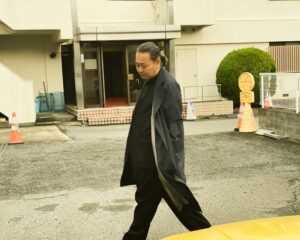
Masafumi Sanai
Photographer
